


 SA
SA
 KW
KW
 IE
IE AU
AU UAE
UAE UK
UK USA
USA
 CA
CA DE
DE
 QA
QA ZA
ZA
 BH
BH NL
NL
 MU
MU FR
FR

















📌 Key Takeaways
- React Native enables faster development with a single codebase for iOS and Android.
- Native app development offers better performance and platform-specific experience.
- React Native helps reduce development cost and time.
- Native apps provide higher scalability and advanced functionality support.
- The right choice depends on project goals, budget, and app requirements.
React Native has steadily moved from being an experimental framework to one of the most widely adopted choices in mobile app development. Some of the bigger brands in the market, such as Facebook, Instagram, Pinterest, Uber, Discord, and Skype, among other, have adopted this framework in their app solutions
If you observe closely then you would be surprised to see the growth of the React Native community. According to the React Native GitHub repository, the framework is supported by 2,000+ contributors globally, reflecting a highly active open-source ecosystem. It also continues to record hundreds of thousands of weekly downloads on npm (npm Registry), showing consistent developer trust and usage at scale.
But hold on, there is another side of the story waiting for you as well.
Despite React Native’s success, still many out there believe in the conventional approach of moving ahead with Native app development, whereas some argue to have only React Native for their development cycle.
So react native or native app development?
Hmmm, a tricky situation…isn’t it?
The answer is not as easy as it may seem. Both approaches bring their own strengths, limitations, and ideal use cases. To take the best out of both, it is highly crucial to carefully consider what best these two technologies have got to offer.
In this article, we are going to weigh in on the matter by identifying the reasons that make React Native and Native so popular, and how embracing any of them works well under the hood for your business.
Based on insights from our experienced and highly-qualified React Native app developers’ team, we’re going to give an overview of both technologies and point out their main benefits and drawbacks worth knowing before making a choice one way or another.
Here we go…
React Native

It is a JavaScript framework and is one of the most popular frameworks used for cross-platform app development. It allows developers to build applications for both iOS and Android using a single codebase. It is open-source with a glut of benefits for development. Backed by Meta, it has become one of the most widely adopted frameworks for building scalable and cost-effective mobile applications.
Pros of React Native
- Single Code Base– yes, this is the best benefit to avail from React Native, it lets the app development for two different platforms to use one single code base.
- Lower development time- The single code base utilization, helps the developers to save time in development.
- JavaScript brings ease- React Native apps are based on JavaScript framework, which makes development easier for developers.
- Hot Reloading- This feature helps developers to make the changes in the app in real-time, and save their time and effort.
- Cost-effective-As React Native uses a single codebase, it makes it easier for developers to reuse app components, leading to lesser cost in development.
Cons of React Native
- Lesser Native elements- RN is in the nascent stage, and as of now, it doesn’t allow any mobile application development company to use different native elements of the device such as Voice Recorder, Camera, etc.
- Limited third-party libraries- There is a lack of third-party libraries, that requires developers to incorporate the native modules, which increases the development efforts.
- Not all Native APIs are present- RN still needs to grow to use all Native APIs.
Just Read : AI Meets React Native App Development in Dubai’s Tech Revolution
When should you choose react native?
React Native works best when speed, efficiency, and cross-platform reach matter more than deep native-level complexity. You should consider React Native if:
- You want to launch your app faster with a single codebase for iOS and Android
- You are building an MVP or startup product and need quick market validation
- You have a limited budget and want to reduce development and maintenance costs
- Your app does not rely heavily on advanced hardware features or complex 3D performance
- You need frequent updates and faster iteration cycles
- You are targeting both Android and iOS users from day one without doubling development effort
In short, React Native is a strong choice when your priority is building a scalable product quickly, without compromising too much on performance or user experience.
Native framework
The native framework works in accordance with the requirements and guidelines of a particular operating system, such as iOS or Android. Here, apps are built separately for each operating platform using platform-specific languages and tools.
Also Read : Why is React Native the Best Choice for Mobile App Development?
Pros of Native
- APIs accessibility- Every device has different APIs with inbuilt functionalities that can easily be utilized with the native framework.
- Third-Party libraries- Native comes with a wide variety of third-party libraries to choose from.
- Robust performance- The development of resource-intensive apps using 3D/AR/VR technology become easy with Native
Cons of Native
- Two apps development- This is the major downside of Native, where developers need to build two different apps for one product, which consumes the developer’s double efforts.
- More development time- As the app development for two different platforms, the time of development increases.
When should you choose native development?
Native development makes sense when performance, precision, and full access to device capabilities are non-negotiable. You should choose native development if:
- Your app needs high performance, especially for complex animations, gaming, or real-time processing
- You require deep integration with device hardware like camera, GPS, sensors, Bluetooth, or AR/VR features
- You want the best possible user experience tailored specifically for iOS or Android guidelines
- Your application is resource-intensive (for example, fintech apps, video editing tools, or enterprise-grade systems)
- You are building a long-term product where scalability and platform optimization are top priorities
- You are okay with higher development time and cost in exchange for maximum stability and control
In simple terms, native development is the better choice when your product depends heavily on performance, platform-specific features, and a highly polished user experience.
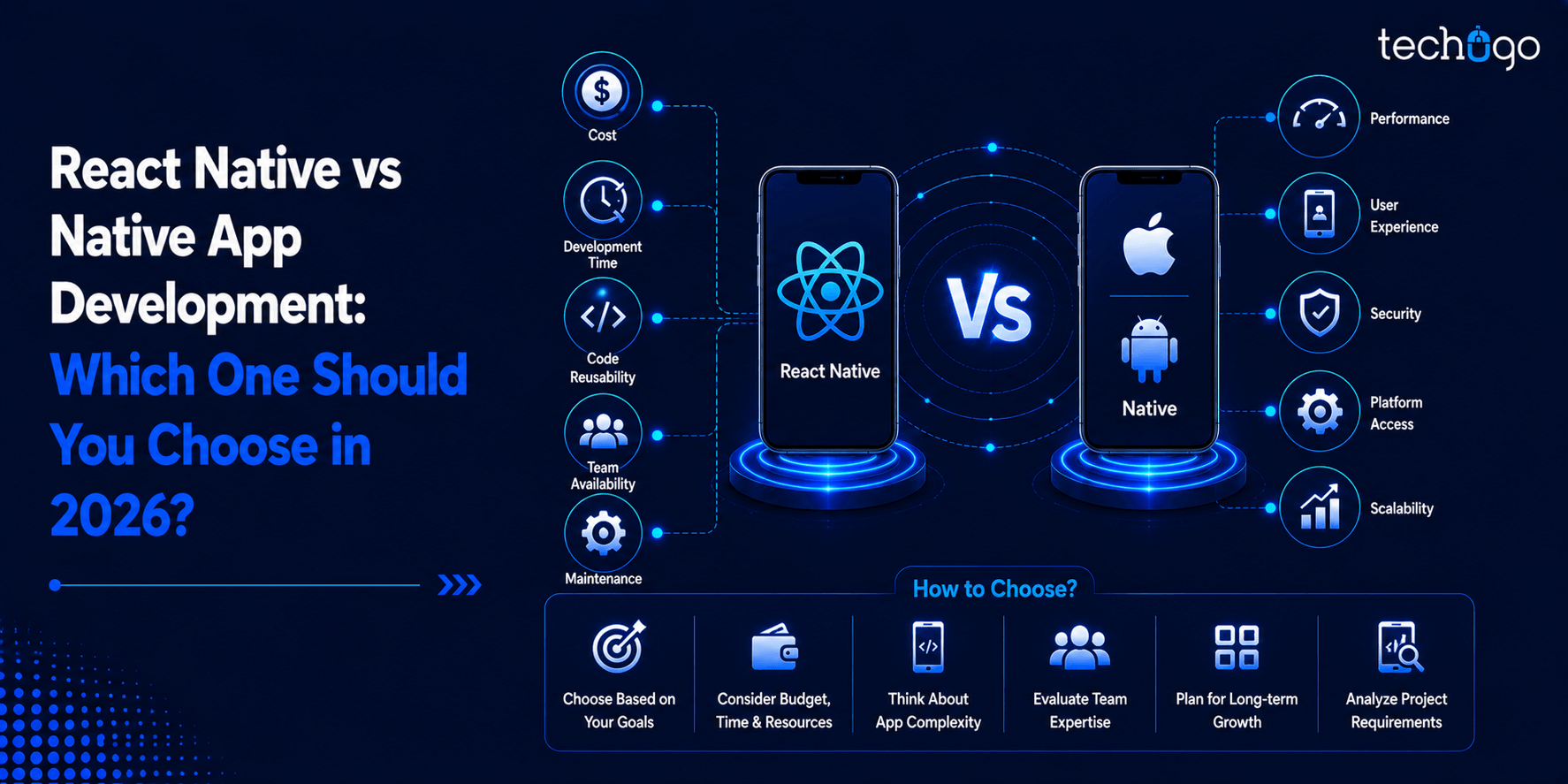
React native vs. native development in 2026
| Factor | React Native | Native Development |
| Development Approach | Single codebase for iOS & Android | Separate apps for each platform |
| Development Speed | Faster due to shared codebase | Slower as separate development is required |
| Cost | Lower cost (shared resources) | Higher cost (dual development teams) |
| Performance | Good, but slightly below native in complex cases | Highest performance and optimization |
| UI/UX Experience | Near-native experience | Fully native, most polished experience |
| Access to Device Features | Limited, may need native modules | Full access to all device APIs |
| Maintenance | Easier with one codebase | More effort due to two separate codebases |
| Scalability | Good for most apps, may need native bridges for scale | Highly scalable for complex, long-term apps |
| Ideal Use Case | MVPs, startups, cross-platform apps | High-performance, feature-rich apps |
React native vs. native: Which is better?
Honestly, there is no universal winner here. Both React Native and native development are powerful in their own ways, and the “better” choice completely depends on what you are trying to build.
If your goal is speed, cost efficiency, and reaching both iOS and Android users quickly, React Native usually makes more sense. It helps you launch faster with a single codebase and is especially strong for MVPs, startups, and cross-platform products.
On the other hand, if your app demands high performance, deep device integration, or a highly refined platform-specific experience, native development is the stronger choice. It gives you full control over the operating system and delivers the best possible performance.
So, it’s not really React Native vs native as a competition. It’s more about matching the right approach with the right product.
A simple way to decide:
- Choose React Native when you want faster development, lower cost, and cross-platform reach
- Choose Native when performance, precision, and platform-specific optimization are critical
Both approaches can build robust, scalable applications. The smarter decision is not picking the “best” technology in general, but selecting the one that aligns with your product goals, timeline, and long-term strategy.
Have more queries in your mind?
Or you’re still confused about whether to choose React Native or native development?
You don’t have to figure it out alone.
Connect with Techugo anytime, and our experts will help you evaluate your idea, requirements, and business goals to recommend the right path for your app.
FAQs
Q. I have a budget constraint. Will React Native help me?
Of course, it will. React Native is all about being faster and cheaper, sans any compromise made on the app’s features and performance. For a budget-constraint product, it is indeed the best choice.
Q. Will React Native help me get an app without compromising the code’s quality?
With React native your app development process expedites, but that has nothing to do with the code quality, and it remains as relevant as it could be. Worth to mention the app performance goes higher with the React Native development.
Q. Do bigger brands use React native?
Yes, some of the most popular apps are built with React Native, like Bloomberg, Gyroscope, and Uber Eats, to name a few.
Q. Why should I consider React Native for my startup in 2026?
Well, there are many reasons to pick React Native for your development journey in 2026, and when it comes to choosing it specifically for your startup, then reasons are more specific, such as:
- App gets delivered sooner and at a lower cost
- App testing becomes easier
- A perfect option for the MVP model

Get in touch
We'd love to hear from you.