

 SA
SA
 KW
KW
 IE
IE AU
AU UAE
UAE UK
UK USA
USA
 CA
CA DE
DE
 QA
QA ZA
ZA
 BH
BH NL
NL
 MU
MU FR
FR















‘How much does the mobile app development cost in 2026?’ is the primary question asked by business owners or entrepreneurs looking forward to digitizing their business this year.
Sure, we agree that every item comes with a price tag but unsurprisingly this is not the case with mobile app development, as it doesn’t have a definite expense.
For instance, think of a smartphone that you must have purchased recently. Did you compare prices before buying the same? The possibility is also that the price varies due to the difference in elements like brand, features, etc.
Getting back to figuring out the app development cost in 2026, it demands investment, and a high budget must be set to develop an app that reaps you higher ROI in the future.
Additionally, app development expenses depend on numerous factors; therefore, it can be hard to define the figure if you’re doing it for the first time.
But don’t worry, we have got you covered. This article will precisely talk about the factors that influence the cost of mobile app development, along with practical insights to help you plan your budget more effectively.
So, let’s get started.
Also Read: How Much Does It Cost to Develop an IoT App in 2026? Pricing & Smart IoT Solutions
What Is the Average Cost of Mobile App Development in 2026
Calculating the average cost of mobile app development in 2026 is not as simple as giving one number, that is because every app is different. Every business has different needs. So the final app development cost depends on many things (app type, platform choice, and the features you want). Hence it was never meant to be a fixed amount. So that you can still plan your budget properly, it is helpful to look at general cost ranges. These ranges are not exact but they show what businesses usually spend when they build a mobile application in today’s market.
Also Read: Cost of Developing an AI-Powered Mobile App in 2026
Basic Apps (Low Complexity)
- Cost Range: $10,000 – $40,000
These apps are built with only essential features, and they were designed to perform simple tasks. You will usually see them used for:
_Utility purposes like calculators, reminders, or simple tools
_Informational use such as event apps or brochure-style apps
_Basic business apps that show services or contact details
They are often treated as simple mobile apps, and they are used when you want to test an idea, or when an MVP has to be launched quickly, but with limited features.
Mid-Level Apps (Moderate Complexity)
- Cost Range: $40,000 – $120,000
These apps were built with more functions, and they are closer to what users expect today. They usually include:
_User login and profile creation
_Integration with APIs such as payment systems and maps
_Databases and basic analytics
_More effort in UI and UX design
Such apps are common in eCommerce platforms, service booking apps, and marketplace models, because they need both usability and performance, and therefore cost more than basic apps.
Advanced Apps (High Complexity)
- Cost Range: $120,000 – $350,000+
These apps are complex, and they were created to handle large data volumes and advanced processes. They often involve:
_Real-time chat or live tracking
_AI-based features like chatbots or recommendation engines
_Strong backend systems
_AR, VR, or data-driven dashboards
Industries like healthcare, fintech, and logistics usually require this level of development, because the systems have to be secure, and scalable, and reliable.
Enterprise-Level and Custom Solutions
- Cost Range: $350,000 – $1M+
These applications are built for large organizations, and they were designed to support thousands of users at the same time. They include:
_High security and compliance features
_Multiple modules and internal dashboards
_Automation tools and enterprise analytics
_Long-term maintenance and support
Such apps are not just products, but platforms, and therefore the app development cost rises as the business operations become more complex.
Why are these cost ranges not fixed? Because many elements are involved, and those elements have been shaping app pricing in 2026. This includes AI integrations, automation, cloud infrastructure, third-party services, etc.
So, the purpose of knowing these ranges is not to lock your budget to one number…but to understand where your app idea fits and how much investment it may require so that you can plan your mobile app development budget more realistically.
Factors That Determine the Overall App Development Expense
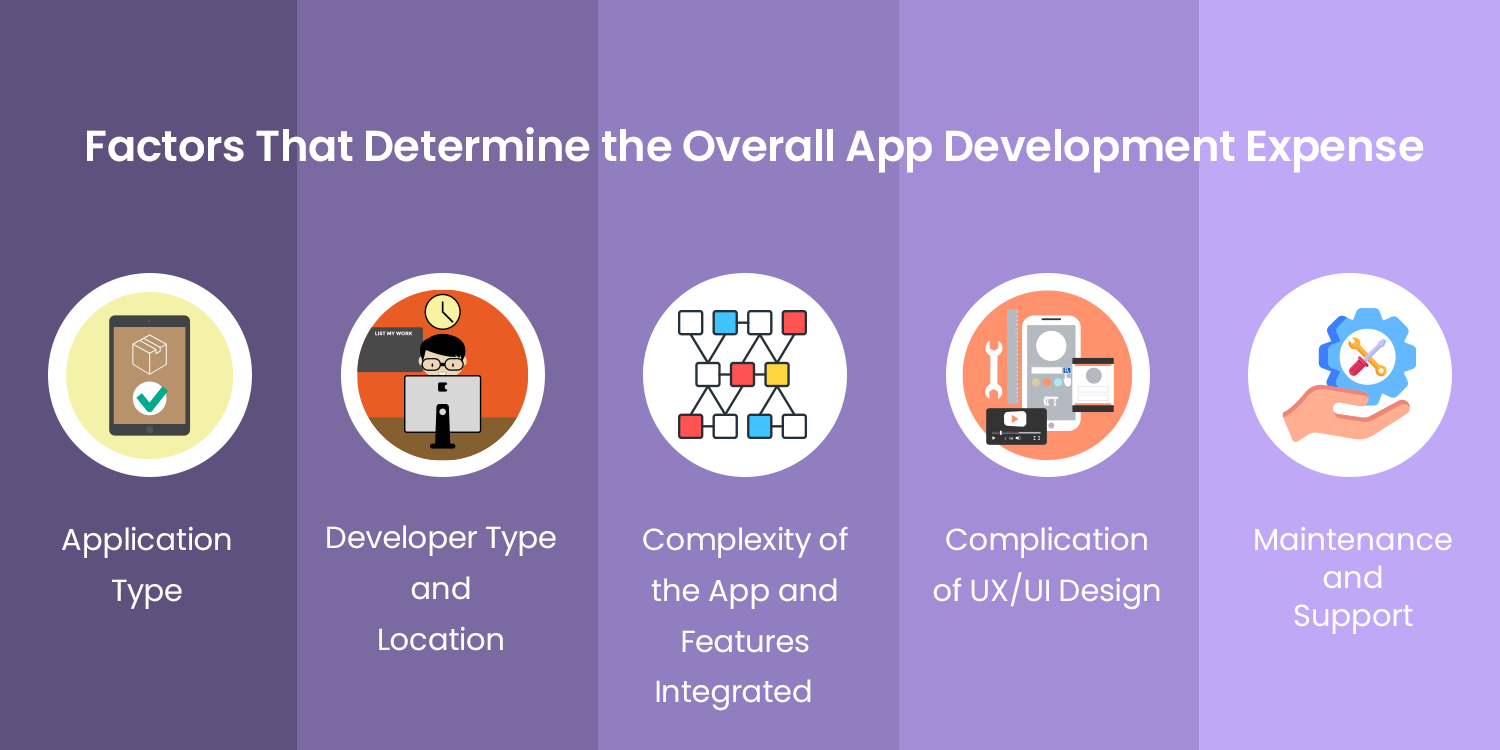
Some of the significant factors that shapes the cost of mobile app development are:
1. Application Type
In today’s world, there’s a mobile app for everything! For any activity from grocery shopping to healthcare, consumers reach out to their smartphones and download a certain app to get the job done. Therefore, it is one of the reasons that entrepreneurs opt to shift their business online!
Notably, app development of each domain varies; therefore, the amount you’re going to invest in the process depends on the application type. Some of the most popular apps are:
- Basic apps like calculators, clocks, etc.
- Data-driven apps like maps, weather forecasts, etc.
- Social media app
- E-commerce app
- On-demand app
AND MORE!
2. Developer Type and Location
App development cost also varies with the vendor’s location and type of development service. For instance, three primary vendors are: small firms, specialist companies, and massive agencies.
- Small firms usually comprise freelancers who might be capable enough to develop basic apps; however, they may lack extended knowledge on dealing with the complexities. Therefore, mobile app development costs may be low!
- Specialist companies emphasize software development that provides every little detail on the project. These companies can be a tad expensive; however, the results delivered are of the utmost quality.
- Large agencies have a brood of high-skilled professionals and have the highest development costs due to their not-compromising-with-any-detail nature.
As mentioned earlier, the vendor’s location is another factor to consider while estimating the app development cost. For instance, the average developer’s cost in the US is $100-150 per hour, while in Western Europe it is $46-$100 per hour.
3. Complexity of the App and Features Integrated
Talking about the app features, the more the features are added, the higher will be the cost. On the other hand, complexity of the app is another crucial factor in determining the overall expense.
Many entrepreneurs chose to incorporate technologies like Artificial Intelligence, Blockchain, etc., which boosts the complexity of the project, leading to higher prices.
4. Complication of UX/UI Design
It has become more crucial than ever to emphasize users’ demands and desires. Therefore, developers prioritize user experience, like simple navigation, high performance, etc., during the app development.
Additionally, the custom app development cost is calculated based on personalized UI/UX design, including buttons, fonts, etc.
5. Platform Choice
The platform you choose also affects the mobile app development cost, because each platform needs different tools and effort. You may build an app for iOS, or for Android, or for both, but every choice changes the budget, and therefore the final cost.
If you choose only an iOS app, development can be faster, but it still depends on features and design. An Android app, however, needs testing on many devices and screen sizes, so the work and time are more, and so the cost may rise.
If your app must run on both platforms, you can go with native development for iOS and Android, but then two codebases are built, and therefore the cost is higher. Another option is cross-platform app development, where one codebase is used for both, so that the app development cost can be controlled, but performance and customization may differ.
You may also choose a Progressive Web App (PWA), which runs in a browser and works like an app. This option is used when faster launch and lower cost are needed, but it does not support all device features, and so its use is limited.
So, platform choice is not only about users, but also about budget and app complexity. Because of this, the decision between iOS, Android, cross-platform, or PWA plays a major role in the final cost of mobile app development.
6. Maintenance and Support
The app developer’s job does not end as soon as the app is developed and launched, but it starts after the same.
The objective behind app development for a business is to enable boosted sales. Therefore, if the app is abandoned post-launch, the software will be outdated.
The fix?
The solution is to keep a check on maintenance, bug fixing, updates, etc., for continuous insights to work on the same. If done accurately, it will also help the business by keeping its customers hooked to the application.
Cost of Integrating Advanced Technologies in 2026
In 2026, many businesses want their apps to be smarter, and faster, and more automated, but adding advanced technologies also increases the mobile app development cost, because more logic, more testing, and more infrastructure are required.
- When features like Artificial Intelligence and machine learning are added, the app is no longer just a simple product, but it becomes a system that learns and processes data. This includes chatbots, recommendation engines, and image or voice recognition. These features need training models, APIs, and strong backend support, therefore the app development cost goes up.
- If your app uses blockchain technology, it needs secure transaction handling and decentralized logic, and so the development process becomes more complex. This is common in fintech and data-security apps, where accuracy and trust are critical, but the cost is also higher because of custom architecture.
- Technologies like AR and VR are used in real estate, education, and retail apps, but they require special design, 3D assets, and device-level optimization. Because of this, the time spent on development is more, and therefore the total cost increases.
- For apps connected to IoT devices, extra work is needed to manage sensors, real-time data, and hardware communication. These apps are built not only for users, but also for machines, and so the system has to be stable and scalable.
So, while advanced technologies make apps more powerful, they also make them more expensive to build. The final cost of mobile app development in 2026 depends on which technologies are used, how deeply they are integrated, and how much data and automation the app is expected to handle.
Post-Launch Costs You Must Budget For
The app development process does not end when the app is launched, and that is because the app must be maintained, updated, and supported over time. These ongoing needs add to the mobile app development cost, and they must be planned in advance.
After launch, costs are linked to bug fixes and performance updates, so that the app continues to work smoothly on new OS versions and devices. There are also costs for feature upgrades, because user needs change, and the app has to evolve.
You also have to consider server and cloud hosting charges, because user data and traffic grow over time. In addition, customer support and app monitoring tools create regular expenses, but they help keep the app stable and usable.
So, while launch is an important step, the real cost of mobile app development continues after release, and therefore post-launch planning becomes a key part of your overall budget strategy.
How Long Does It Take to Develop an App in 2026?
Since there are many AI tools for coding available but still, app development takes time, and that is because planning, testing, and integration cannot be skipped. The timeline depends on the app type, the features added, and the platform chosen, therefore there is no single fixed duration.
A basic mobile app with limited functions may take 2 to 3 months, because the design is simple and the backend work is minimal. These apps are often built as MVPs, so that ideas can be launched faster.
A mid-level app with user login, APIs, and standard integrations may take 4 to 6 months, since more development and testing are required, and so the process becomes longer.
An advanced app with AI features, real-time data, or strong security layers can take 6 to 12 months or more, because system architecture and performance testing take extra effort.
So, even with automation and smart tools, app development in 2026 still needs time, and the timeline is closely linked to the mobile app development cost, therefore planning early helps control both time and budget.
Tips to Reduce Mobile App Development Cost Without Hurting Quality
- Start with an MVP, because building only core features first helps control the mobile app development cost.
- Choose cross-platform development when possible, so that one codebase can serve both iOS and Android.
- Finalize your requirements early, because frequent changes increase time and therefore increase cost.
- Use ready APIs and third-party tools, so that custom development work is reduced.
- Focus on simple UI first, because complex design increases both development and testing effort.
- Work with an experienced app development team, so that mistakes and rework are avoided.
- Plan post-launch updates in phases, because spreading features over time helps manage budget.
- Test early and often, so that bugs do not become expensive fixes later.
Why Hire Techugo for Custom Mobile App Development
Any worthy app development company would emphasize the growth and development of your business by developing an efficient product.
Therefore, if you have a flawless app idea and want to discuss it with the professionals, schedule a consultation with Techugo, the best mobile app development company, by following the steps mentioned above.
Techugo builds custom mobile apps for startups and enterprises, using modern technologies and a business-first approach, so that products are ready for real users.
So, are you all set?
Need detailed insights on the cost of app development? Hear from our industry expert!

Get in touch
We'd love to hear from you.